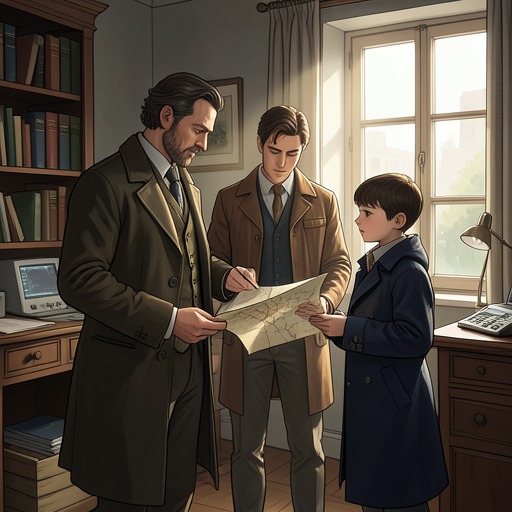
Henry Lawson and Professor Hardwigg
A Journey to the Centre of the EarthHenry Lawson and Professor Hardwigg are uncle and nephew, but their relationship is also the expedition’s intimate counterpoint to its scientific ambition. The Professor’s commanding temperament and hunger for discovery repeatedly unsettle Henry; affection, intellectual fellowship, and practical care nevertheless bind them together, until the journey’s dangers reveal how much each depends on the other.
Family and shared scientific life
Professor Hardwigg, a German who married Henry’s English aunt, invited his fatherless nephew to study with him in his home in the fatherland. The family tie became an intellectual apprenticeship: Henry attended the Professor’s lectures, hoped to become nearly as learned, and shared his particular preference for mineralogy. Geology and mineralogy occupied their lives, with the two breaking specimens of stone, chalk, and metal with their hammers. Their household’s ordinary rhythms reflected that devotion: steel rods, loadstones, glass pipes, and bottles of acids were more often before them than meals.
Henry describes his uncle as learned and kind, but also choleric and original, a man whose authority demanded obedience. His habits made their exchanges vivid rather than serene: he stammered when explaining difficult subjects and could replace a missing technical term with a powerful adjective. His learning had a practical, classificatory side, too; he had once sorted six hundred geological specimens by weight, hardness, fusibility, sound, taste, and smell. Henry’s closeness to the Professor therefore rests on more than kinship. He admires his knowledge, shares his scientific interests, and is accustomed to living within the reach of his forceful personality.
Ambition, disagreement, and evidence
When Henry discovers Saknussemm’s directions, he recognizes that his uncle’s imagination may turn a scientific clue into mortal danger. Watching the Professor struggle through a sleepless night over the possibility of the journey, Henry knows one word could relieve his suffering, but chooses silence because revealing the secret would send his uncle toward destruction and drag Henry with him. His protective hesitation gives way when the Professor announces that they will start at once. Henry is horrified, yet prepares to argue against the expedition through scientific reasoning rather than simply defying his uncle.
Their disagreement becomes explicit when Henry maintains that established theoretical and practical science makes a descent to the centre of the Earth impossible. He invokes the accepted increase of temperature with depth and the expected heat and fusion beneath the crust; the Professor answers that he cares nothing for theories. The contrast does not reduce their relationship to a simple opposition between a wrong authority and a right pupil. The Professor can reason from observation, while Henry’s caution is itself grounded in scientific knowledge. On the journey, Henry points out fossil signs and presents a shell for his uncle’s judgment; the Professor identifies it as a trilobite, an extinct crustacean, while declining to draw the larger conclusion Henry presses upon him. Each tests what the other sees and what a discovery permits them to claim.
The same contest between calculation and experience recurs underground. When their depth reaches sixteen leagues, or fifty miles, Henry argues that this approaches the extreme limit allowed by science for the thickness of the crust. He then uses the known laws of increasing heat to challenge the conditions around them. The Professor does not deny Henry’s account of the accepted limit, but sets it against their direct experience: the thermometer registers only 27.6 degrees Réaumur, far below the temperature the theory predicts at that depth. He invokes the stubbornness of facts and credits Humphry Davy’s view, while Henry remains willing to accept the measurement without adopting his uncle’s entire explanation. Their bond accommodates argument: Henry can speak plainly, and the Professor can invite him to make his case.
Care under pressure
The expedition’s harshest moments reveal the tenderness that Henry’s description of his uncle’s authority might obscure. After the pair and Hans crawl for hours through an arid passage and reach a junction on July 7, Henry collapses, scorched and exhausted. The Professor lifts him tenderly and calls him a poor boy in a tone of deep sympathy. Henry, unused to such a display of weakness from his uncle, takes his trembling hands and feels them clasped without resistance; the Professor’s eyes are wet with tears. The scene reverses the usual direction of care. The nephew, normally the more vulnerable member of the pair, reaches out to comfort the man who has brought him into danger.
The Professor’s care is also materially exact. He gives Henry the last mouthful of water from his bottle, explaining that he had saved it for him despite resisting his own thirst many times. He had anticipated that Henry would collapse at the crossroads and reserved the water to restore him. The gesture makes their affection more than a declaration: a finite supply, guarded through deprivation, becomes the means by which the Professor sustains his nephew. Earlier, Henry feared that loyalty would pull him into disaster; here, the same shared journey exposes the care that makes their dependence reciprocal.
Knowledge made together
Their relationship gives the scientific narrative a human measure. The Professor’s organized instruments and notebook turn travel into recorded inquiry, while Henry’s geological training supplies questions and counterarguments. In the underground world, a fish that initially resembles a small sturgeon becomes the subject of the Professor’s careful examination. Henry offers an identification; the Professor notes its flat head, round body, bony scales, toothless mouth, and highly developed pectoral fins, then concludes that it belongs to a family long extinct and otherwise known only from Devonian fossils. They reach knowledge through attention and correction rather than through either man’s authority alone.
The book’s earlier account of the human jawbone discovered at Moulin-Quignon near Abbeville also shows the wider scientific stakes surrounding the Professor. A jawbone found fourteen feet underground with stone hatchets and carved flints had stirred fierce disputes about fossil human remains. The Professor was among its most enthusiastic supporters. Henry’s relation to him thus joins family loyalty to a shared participation in contested science: the nephew accompanies a man whose appetite for discovery can outrun caution, yet whose claims belong to a larger effort to understand the Earth through evidence.
Even the journey’s instruments make their disagreements consequential. As boiling water and excessive heat suggest a new disturbance, Henry examines the compass and finds its needle leaping from pole to pole, circling, and abruptly reversing. Observation does not always settle an argument; sometimes it supplies a fresh anomaly the pair must confront together. Across their journey, Henry’s skepticism checks the Professor’s confidence, the Professor’s experience challenges Henry’s received laws, and both are forced to revise their understanding in the presence of things that their theories did not predict. Their enduring relation is therefore neither simple obedience nor a clean transfer of authority. It is an uneasy but affectionate partnership, sustained by kinship, shared inquiry, and acts of care under pressure.